الدير البحري
1458 BC
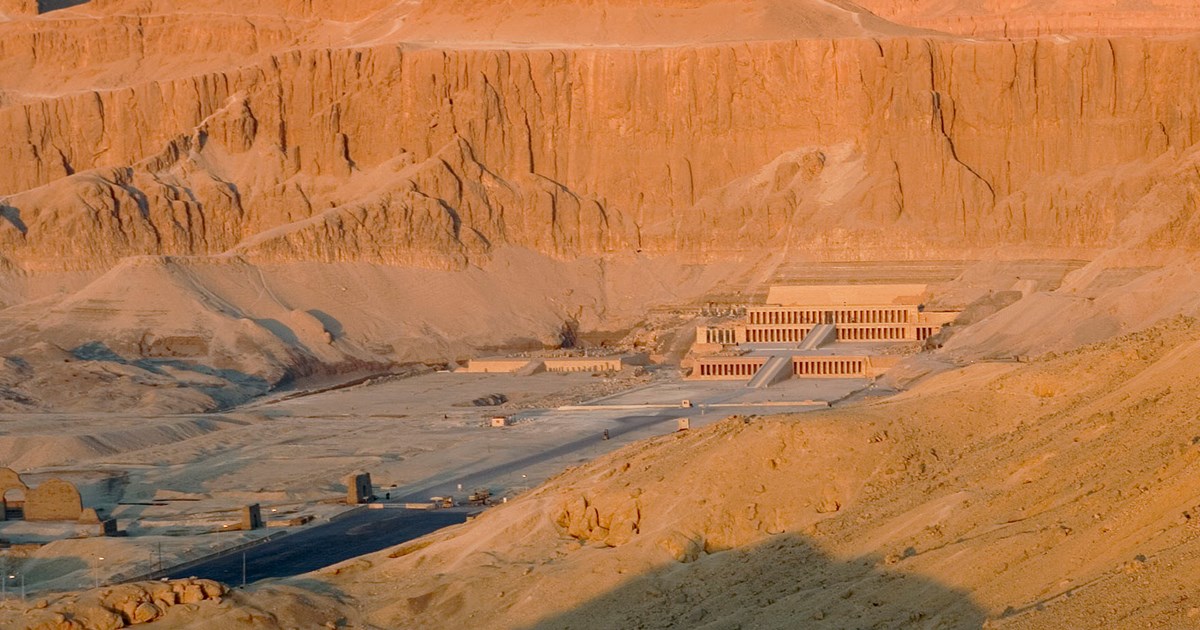
The celebrated temple of Hatshepsut (c.1473–1458 BC), the queen who became pharaoh, is located here, in Deir al-Bahari, on the west bank of Luxor. Composed of three man-made terraces that gradually rise up toward the sheer cliff face, this structure is truly a sight to behold. The site of Deir al-Bahari was sacred to Hathor, the goddess who nursed and reared every king, including their mythological ancestor, the god Horus, in Egypt’s primordial past. A manifestation of this goddess was believed to reside in the very hills under whose shadow lies the temple of Hatshepsut, and just on the other side of which is the site of the tombs of some of ancient Egypt’s most famous rulers, the Valley of the Kings. Stelae bearing prayers to Hathor depict her, in cow form, emerging from these mountains. This impressive geological formation features a summit that is naturally pyramid-shaped. This was the reason why king Nebhepetre Mentuhotep (c.2055–2004 BC) chose this hallowed location as the site of his tomb and mortuary temple, 600 years before Hatshepsut set foot here. Royal mortuary temples complemented tombs, and the cults of deceased kings were maintained in these structures for the continued survival of their souls in the hereafter. The most prominent feature of Mentuhotep’s temple-tomb was a monumental structure, believed by some to have been a mastaba, which rose from the center of the main terrace. The temple of Hatshepsut, the ‘Holy of Holies’, served as a mortuary temple for the female pharaoh and her revered father, Thutmose I. Sunset was regarded as the daily death of the sun god before his glorious rebirth in the east. Given its funerary nature, Hatshepsut’s mortuary temple was built on the west bank of the Nile, directly across the river from the main temple of Amun in Karnak. The statues of this god, his wife Mut, and their son Khonsu left their temples every year during the Opet festival (Beautiful Feast of the Valley), and crossed the Nile to visit the royal mortuary temples, including Hatshepsut’s, which appears to have been one of their most important stops.
نظرة عامة
The celebrated temple of Hatshepsut (c.1473–1458 BC), the queen who became pharaoh, is located here, in Deir al-Bahari, on the west bank of Luxor. Composed of three man-made terraces that gradually rise up toward the sheer cliff face, this structure is truly a sight to behold.
The site of Deir al-Bahari was sacred to Hathor, the goddess who nursed and reared every king, including their mythological ancestor, the god Horus, in Egypt’s primordial past. A manifestation of this goddess was believed to reside in the very hills under whose shadow lies the temple of Hatshepsut, and just on the other side of which is the site of the tombs of some of ancient Egypt’s most famous rulers, the Valley of the Kings. Stelae bearing prayers to Hathor depict her, in cow form, emerging from these mountains. This impressive geological formation features a summit that is naturally pyramid-shaped.
This was the reason why king Nebhepetre Mentuhotep (c.2055–2004 BC) chose this hallowed location as the site of his tomb and mortuary temple, 600 years before Hatshepsut set foot here. Royal mortuary temples complemented tombs, and the cults of deceased kings were maintained in these structures for the continued survival of their souls in the hereafter. The most prominent feature of Mentuhotep’s temple-tomb was a monumental structure, believed by some to have been a mastaba, which rose from the center of the main terrace.
The temple of Hatshepsut, the ‘Holy of Holies’, served as a mortuary temple for the female pharaoh and her revered father, Thutmose I. Sunset was regarded as the daily death of the sun god before his glorious rebirth in the east. Given its funerary nature, Hatshepsut’s mortuary temple was built on the west bank of the Nile, directly across the river from the main temple of Amun in Karnak. The statues of this god, his wife Mut, and their son Khonsu left their temples every year during the Opet festival (Beautiful Feast of the Valley), and crossed the Nile to visit the royal mortuary temples, including Hatshepsut’s, which appears to have been one of their most important stops.
The Middle Kingdom was a time of great prosperity. It consists of the Eleventh to Thirteenth Dynasties. Although the Eleventh Dynasty had its origins in the First Intermediate Period, it is a later king in this same royal family who reunified Egyp.
During the New Kingdom, Egypt became a great empire of the ancient Near East. Its southern borders reached the Fourth Cataract in Nubia, and to modern-day Syria in the north. The economy flourished to an astounding degree, and most of the most fam.
The Ministry launches “Hekayetna" initiative to raise tourism and archaeological awareness among school students Last week, the Department of Cultural Development and Community Communication in the Office of the Minister of Tourism and Antiquit.