الكرنك
305 BC–30 BC
Aptly called Ipet‑Sut ‘The Most Select of Places’ by the ancient Egyptians, Karnak was one of the most important sites of all. Located on the east bank of Thebes (modern Luxor), Upper Egypt, it is the site of many temples and chapels, and it was in the Great Temple of Amun that the cult of the god Amun of Thebes was conducted. As such, it was extremely wealthy and its priesthood held great political power. The line of kings who reunified Egypt after the First Intermediate Period hailed from Thebes. It thus became one of the most important cities, a position that it would continue to hold throughout the majority of ancient Egyptian history. The importance of Amun rose in tandem with the city’s rise to prominence. From the earliest evidence for it from the reign of Intef II (c. 2112–2063 BC) to the Ptolemaic Period (305 BC–30 BC), his temple was accordingly lavished with royal attention in the form construction projects, ritual equipment and other necessities, with some additions in the Roman Period (30 BC–AD 306). Nearly every king who reigned during the New Kingdom (c. 1550–1069 BC), Egypt’s age of empire, left his mark here. Karnak was in reality a complex of temples, consisting of several zones: In addition to the largest, the Amun Precinct, there are the Precinct of Mut, his wife, to the south; the Precinct of Montu to the north; and, to the east, Akhenaten’s temple to Aten. Like most ancient Egyptian temples, the Great Temple of Amun is built on an east–west axis. Ancient Egyptian temples were models of the cosmos, and this layout meant that they mirrored the sun god’s trajectory through the sky. Exceptionally, however, it also possesses a north–south axis, which orients it towards another temple, the abode of Amenemopet known today as Luxor Temple. This was a different version of Amun specific to south Luxor. Karnak and Luxor Temple were linked by a processional way lined with sphinxes. This was used in one of the most important celebrations of the ancient Egyptian calendar, the Opet Festival. In addition to the ancient Egyptians’ mastery of stone, which is evident everywhere in the scale of the monuments, the reliefs covering their walls, and the statues populating them, several highlights are worth mentioning. The temple of Amun’s world‑famous Great Hypostyle Hall is a forest of 134 columns. These massive columns have a height of 15 metres, aside from the larger, central, twelve, which stand 21 metres tall. The hall may have been begun by Amenhotep III (c. 1390–1352 BC; 18th Dynasty), but the bulk of the construction, and all of the decoration, are from the reigns of 19th Dynasty kings Sety I (c. 1294–1279 BC) and his son Rameses II (c. 1279–1213 BC). Two magnificent obelisks stand nearby, the larger of the two, erected by Hatshepsut (c. 1473–1458 BC), standing at a colossal height of almost 30 metres and weighing over 300 tons. At the eastern end of Karnak is the Akh-menu, a temple by Thutmose III (c. 1479–1425 BC) dedicated to the cults of various deities, his royal predecessors, as well as his own cult. The enclosure walls of the Amun Precinct also include a full temple to Khonsu in the southwestern corner, next to which is the temple of Opet, a hippopotamus goddess of childbirth, mostly built in the Ptolemaic Period. The beautiful sacred lake, where priests purified themselves before carrying out temple rituals, can still be appreciated today. Many more, smaller, temples and chapels dot the landscape of Karnak, making it a veritable open‑air museum.
نظرة عامة
Aptly called Ipet‑Sut ‘The Most Select of Places’ by the ancient Egyptians, Karnak was one of the most important sites of all. Located on the east bank of Thebes (modern Luxor), Upper Egypt, it is the site of many temples and chapels, and it was in the Great Temple of Amun that the cult of the god Amun of Thebes was conducted. As such, it was extremely wealthy and its priesthood held great political power.
The line of kings who reunified Egypt after the First Intermediate Period hailed from Thebes. It thus became one of the most important cities, a position that it would continue to hold throughout the majority of ancient Egyptian history. The importance of Amun rose in tandem with the city’s rise to prominence. From the earliest evidence for it from the reign of Intef II (c. 2112–2063 BC) to the Ptolemaic Period (305 BC–30 BC), his temple was accordingly lavished with royal attention in the form construction projects, ritual equipment and other necessities, with some additions in the Roman Period (30 BC–AD 306). Nearly every king who reigned during the New Kingdom (c. 1550–1069 BC), Egypt’s age of empire, left his mark here.
Karnak was in reality a complex of temples, consisting of several zones: In addition to the largest, the Amun Precinct, there are the Precinct of Mut, his wife, to the south; the Precinct of Montu to the north; and, to the east, Akhenaten’s temple to Aten.
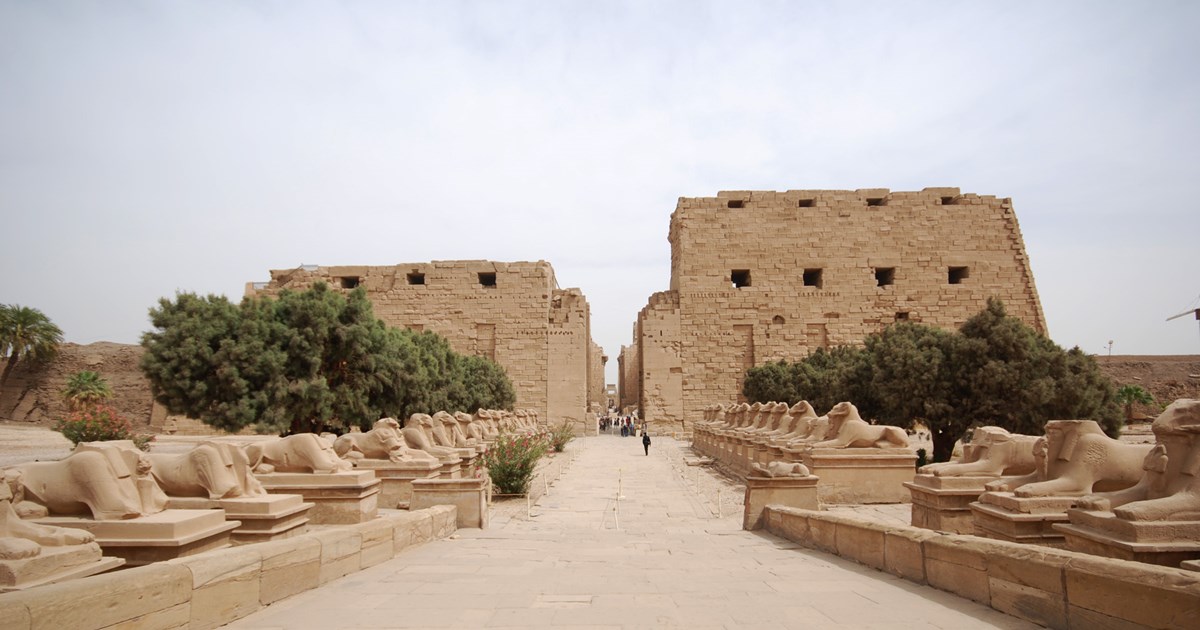
Like most ancient Egyptian temples, the Great Temple of Amun is built on an east–west axis. Ancient Egyptian temples were models of the cosmos, and this layout meant that they mirrored the sun god’s trajectory through the sky. Exceptionally, however, it also possesses a north–south axis, which orients it towards another temple, the abode of Amenemopet known today as Luxor Temple. This was a different version of Amun specific to south Luxor. Karnak and Luxor Temple were linked by a processional way lined with sphinxes. This was used in one of the most important celebrations of the ancient Egyptian calendar, the Opet Festival.
In addition to the ancient Egyptians’ mastery of stone, which is evident everywhere in the scale of the monuments, the reliefs covering their walls, and the statues populating them, several highlights are worth mentioning. The temple of Amun’s world‑famous Great Hypostyle Hall is a forest of 134 columns. These massive columns have a height of 15 metres, aside from the larger, central, twelve, which stand 21 metres tall. The hall may have been begun by Amenhotep III (c. 1390–1352 BC; 18th Dynasty), but the bulk of the construction, and all of the decoration, are from the reigns of 19th Dynasty kings Sety I (c. 1294–1279 BC) and his son Rameses II (c. 1279–1213 BC). Two magnificent obelisks stand nearby, the larger of the two, erected by Hatshepsut (c. 1473–1458 BC), standing at a colossal height of almost 30 metres and weighing over 300 tons. At the eastern end of Karnak is the Akh-menu, a temple by Thutmose III (c. 1479–1425 BC) dedicated to the cults of various deities, his royal predecessors, as well as his own cult.
The enclosure walls of the Amun Precinct also include a full temple to Khonsu in the southwestern corner, next to which is the temple of Opet, a hippopotamus goddess of childbirth, mostly built in the Ptolemaic Period. The beautiful sacred lake, where priests purified themselves before carrying out temple rituals, can still be appreciated today. Many more, smaller, temples and chapels dot the landscape of Karnak, making it a veritable open‑air museum.
Our Services
During the New Kingdom, Egypt became a great empire of the ancient Near East. Its southern borders reached the Fourth Cataract in Nubia, and to modern-day Syria in the north. The economy flourished to an astounding degree, and most of the most fam.
The ancient city of Thebes, modern Luxor in the south of Egypt, was one of the most important cities from the Middle Kingdom (c.2055–1650 BC) onwards. The vast majority of the ancient Egyptian monuments that can still be visited there today were b.
The Ministry launches “Hekayetna" initiative to raise tourism and archaeological awareness among school students Last week, the Department of Cultural Development and Community Communication in the Office of the Minister of Tourism and Antiquit.
A group of rings, amulets and gold jewelry from the 26th Dynasty discovered in Karnak Temples The Egyptian-French archaeological mission affiliated with the French-Egyptian Center for the Study of Karnak Temples (CFEETK), in cooperation with the.