Abu Simbel
1264 BC
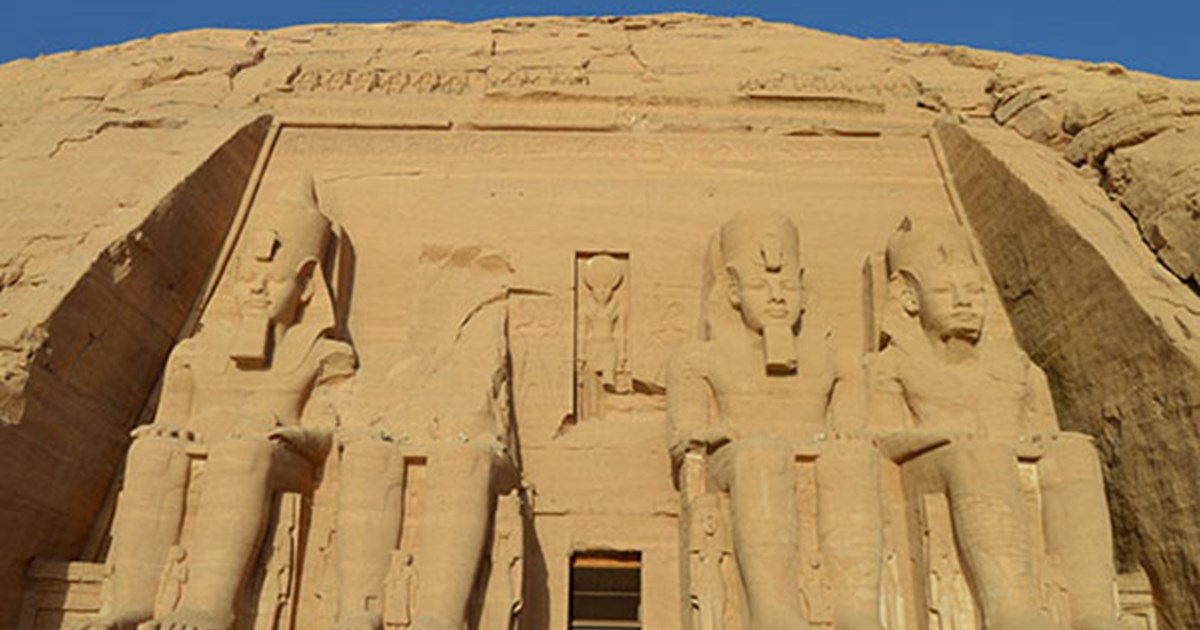
The Great Temple of Abu Simbel, in Nubia near Egypt’s southern border, is among the most awe-inspiring monuments of Egypt. It was cut into the living rock by King Ramesses II (the Great) of the Nineteenth Dynasty, around 1264 BC. The temple is most well known for the four imposing seated colossal statues that dominate its façade. One of these collapsed because of an ancient earthquake, and its fragments can still be seen on the ground. Colossal standing statues of the king line the main hall, leading to the sanctuary where four deities are sat: Amun Ra, Ra Horakhty, Ptah, and a deified version of Ramesses II. The temple was built with such precision that on two days a year, the 22nd of February and 22nd of October, the sun’s rays enter the temple, cross the main hall, and illuminate the innermost statues. Another rock-cut temple to the north, known as the Small Temple, is dedicated to the goddess Hathor and Ramesses II’s Great Royal Wife, Queen Nefertari. On the façade of the Small Temple, her colossi are the same size as those of her husband, a very rare example of such display. The two temples were moved from their original location in 1968 after the Aswan High Dam was built, as it threatened to submerge them. The relocation was completed thanks to an international effort led by UNESCO, and the temple was admitted into its list of World Heritage Sites in 1979.
Überblick
The Great Temple of Abu Simbel, in Nubia near Egypt’s southern border, is among the most awe-inspiring monuments of Egypt. It was cut into the living rock by King Ramesses II (the Great) of the Nineteenth Dynasty, around 1264 BC. The temple is most well known for the four imposing seated colossal statues that dominate its façade. One of these collapsed because of an ancient earthquake, and its fragments can still be seen on the ground.
Colossal standing statues of the king line the main hall, leading to the sanctuary where four deities are sat: Amun Ra, Ra Horakhty, Ptah, and a deified version of Ramesses II. The temple was built with such precision that on two days a year, the 22nd of February and 22nd of October, the sun’s rays enter the temple, cross the main hall, and illuminate the innermost statues.
Another rock-cut temple to the north, known as the Small Temple, is dedicated to the goddess Hathor and Ramesses II’s Great Royal Wife, Queen Nefertari. On the façade of the Small Temple, her colossi are the same size as those of her husband, a very rare example of such display.
The two temples were moved from their original location in 1968 after the Aswan High Dam was built, as it threatened to submerge them. The relocation was completed thanks to an international effort led by UNESCO, and the temple was admitted into its list of World Heritage Sites in 1979.
After the unique solar alignment phenomenon on the sanctum of the iconic Ramses II temple, which takes place on 22 February and 22 October of every year, we will take you on a virtual tour inside this amazing temple. Thank you @nav3d.egypt team. h.
During the New Kingdom, Egypt became a great empire of the ancient Near East. Its southern borders reached the Fourth Cataract in Nubia, and to modern-day Syria in the north. The economy flourished to an astounding degree, and most of the most fam.
Nubia is a geographic region in the south of Egypt and the north Sudan. A number of important sites are located in the region between Aswan and Abu Simbel, and in 1979, ten were added to UNESCO’s World Heritage List. These are, from south to north.
Presenting Egypt’s ancient wonders in modern mediums has never been more appropriate than it is today. With global tourism at a halt, people from all over the world strive to be able to live their favorite trips from the comfort and safety of thei.