Gizeh-Plateau
2494 BC
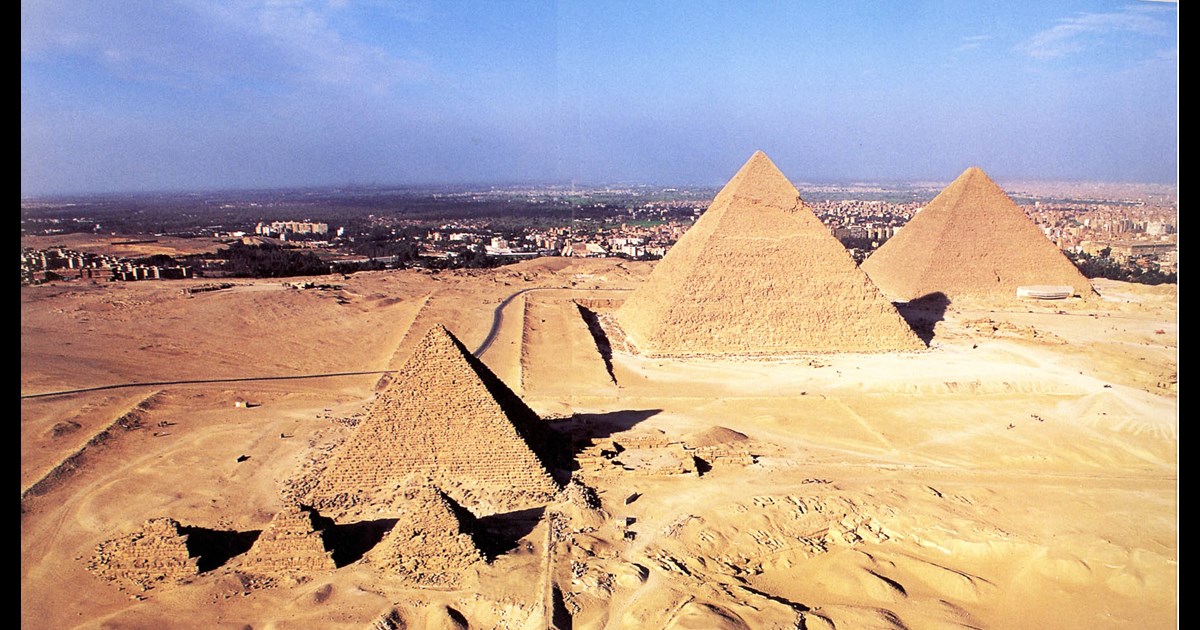
The pyramids of Giza and the Great Sphinx are among the most popular tourist destinations in the world, and indeed already were even in Roman times. Each of these spectacular structures served as the final resting place of a king of the 4th Dynasty (c.2613–2494 BC). The Great Pyramid of Giza was built for king Khufu (c.2589–2566 BC), and the other two for Khafre and Menkaure, his son and grandson. Khufu’s pyramid is both the oldest and largest of the three, and the first building to exceed it in height would not be built for another 3,800 years! Although the three pyramids dominate the plateau, they are in fact surrounded by many other monuments. Every king’s pyramid was just one element albeit the most important of a larger complex that included smaller, subsidiary, queens’ pyramids; an additional one that acted as a second, symbolic, tomb for the king, called a satellite pyramid; mastaba tombs for nobility and other family members; burials of actual and/or symbolic boats; and a pair of temples linked by a richly decorated causeway. One of these temples, called the valley temple, led into the pyramid complex, and was located on or near a body of water where boats could dock. The other, the funerary (or upper) temple, stood near the base of the pyramid. Priests maintained the mortuary cult of the deceased king in these temples, where his divine aspect was worshiped, and where rich and diverse offerings were presented to his soul so he could have a peaceful and luxurious afterlife.
Überblick
The pyramids of Giza and the Great Sphinx are among the most popular tourist destinations in the world, and indeed already were even in Roman times. Each of these spectacular structures served as the final resting place of a king of the 4th Dynasty (c.2613–2494 BC). The Great Pyramid of Giza was built for king Khufu (c.2589–2566 BC), and the other two for Khafre and Menkaure, his son and grandson. Khufu’s pyramid is both the oldest and largest of the three, and the first building to exceed it in height would not be built for another 3,800 years!
Although the three pyramids dominate the plateau, they are in fact surrounded by many other monuments. Every king’s pyramid was just one element albeit the most important of a larger complex that included smaller, subsidiary, queens’ pyramids; an additional one that acted as a second, symbolic, tomb for the king, called a satellite pyramid; mastaba tombs for nobility and other family members; burials of actual and/or symbolic boats; and a pair of temples linked by a richly decorated causeway. One of these temples, called the valley temple, led into the pyramid complex, and was located on or near a body of water where boats could dock. The other, the funerary (or upper) temple, stood near the base of the pyramid. Priests maintained the mortuary cult of the deceased king in these temples, where his divine aspect was worshiped, and where rich and diverse offerings were presented to his soul so he could have a peaceful and luxurious afterlife.
Khaled El-Anany, Minister of Tourism and Antiquities, witnessed signing of a contract for development and participation in management of sound and light shows and exhibition area in Giza Plateau, between Misr Company for Sound, Light and Tourism D.
Under the shadow of the Great Pyramid lies the mastaba of Queen Meresankh III, the wife of Khafre and granddaughter of Khufu. Both very large and exquisitely decorated, this is indeed a tomb worthy of her rank and fortunately also contains the bes.
Many think that there are only three pyramids on the Giza Plateau, when in fact, aside from the massive pyramids of Kings Khufu, Khafre, and Menkaure, there are also the smaller pyramids of their wives, sisters and daughters. There are three such.
Memphis, near the modern village of Mit Rahina not far from Cairo, and its necropolis were added to UNESCO’s World Heritage List in 1979. Said to have been founded by the legendary first king of Egypt Menes in 3100 BC, the ancient city of Memphis.